How Howard Gardner’s Legacy Unlocks Every Child’s Unique Potential
In an age of educational choice, microschools and learner-centered models are redefining what it means to be “smart.” Howard Gardner’s theory of multiple intelligences reminds us that human brilliance is plural—and that to educate for the future, we must nurture the many ways of being intelligent. This essay explores how Positive Education, farm-integrated learning, and small schools turn Gardner’s philosophy into practice, helping every child discover their unique way to flourish.
By Michael Cummins, Editor | October 16, 2025
The Narrowness of “Smart”
Marcus is ten years old and failing the reading test again. His teacher sighs, circles another answer in red, and moves on.
But the test does not see what Marcus can do.
After school, he kneels beside a broken bicycle, arranges its parts on the driveway like puzzle pieces, and restores it to working order. He coordinates his friends, assigning roles, solving conflicts, making the day hum again. He is precise, patient, and intuitively social.
In a nearby microschool, Marcus thrives. He’s invited to design a community bike-repair station, sketch blueprints, and mentor younger students. His intelligence isn’t just recognized—it’s needed.
By conventional standards, Marcus struggles. By any holistic measure, he is a genius of motion, empathy, and applied reasoning.
For more than a century, schooling has valued only two forms of brilliance: linguistic (word-smart) and logical-mathematical (number-smart). The rest—musical, spatial, bodily, interpersonal, intrapersonal—have lived in the margins. Gardner’s work illuminated what education forgot: that intelligence is not singular but symphonic.
The Birth of IQ: A Narrow Lens
The modern concept of intelligence was born in the early 20th century, shaped by Alfred Binet’s efforts to identify students needing support. But what began as a diagnostic tool became a sorting mechanism—ranking minds, allocating futures. IQ became shorthand for human worth, and education followed suit: narrow, numeric, and hierarchical.
By the late 20th century, schooling had become a system for measuring sameness rather than nurturing difference. Into that narrowing frame stepped Howard Gardner.
Gardner’s Revolution: From IQ to a Constellation of Capacities
When Howard Gardner published Frames of Mind in 1983, he quietly changed the meaning of intelligence. His proposition was deceptively simple: human intellect is not a single light but a constellation.
He defined intelligence as “the capacity to solve problems or to fashion products that are of consequence in a particular cultural setting.” The shift was profound. Intelligence was no longer a static number, but a living capacity expressed through action and meaning.
If the traditional IQ model was a single screwdriver, Gardner’s theory was a Swiss Army knife—many tools for many worlds.
This insight laid the groundwork for educational models that treat learning as multidimensional—where children are not sorted by scores but supported by strengths. It also reframed intelligence as a shared inheritance: every child carries a unique combination of capacities waiting for the right environment to emerge.
Expanding the Horizon: Beyond the Seven to Whole-Life Learning
Gardner’s original seven intelligences each open a window into a different way of knowing:
- Linguistic: the storyteller’s gift for shaping thought through language.
- Logical-Mathematical: the analyst’s power to find structure in pattern.
- Musical: the composer’s ear for rhythm and harmony.
- Bodily-Kinesthetic: the maker’s fluency through motion and touch.
- Spatial: the architect’s vision of design and form.
- Interpersonal: the collaborator’s sensitivity to others.
- Intrapersonal: the self-knower’s awareness of emotion and motive.
The Inner Lives: EQ as Legacy
These final two intelligences—Interpersonal and Intrapersonal—are particularly crucial. Long before Emotional Intelligence (EQ) became a popular business and parenting concept, Gardner’s work legitimized the inner lives of students, reminding us that the capacity to read oneself and others is a form of intellect as vital as reading a book or a graph. The mastery of self and relationship is the ultimate foundation for both individual flourishing and global citizenship.
Later came two additions that expanded the theory’s reach:
Naturalistic intelligence recognizes the relationships among living systems. In farm-integrated environments, this intelligence flourishes. Children learn biology by tending soil, study systems by observing pollinators, and develop ecological empathy through daily stewardship.
Existential intelligence asks the largest questions—about purpose, justice, and meaning. It belongs to the child who wonders, “Why do we exist?” before breakfast, and who senses that curiosity itself is sacred.
Gardner’s evolving map of mind mirrors life itself: dynamic, adaptive, and alive.
Institutional Inertia vs. the Flourishing Mandate
If Gardner’s insight liberated the imagination of teachers, the structure of schooling has too often constrained it.
The problem is not cruelty—it is efficiency. Standardized tests make comparison easy but understanding difficult. They promise accountability but flatten diversity. Systems built for speed and measurement neglect the slow, relational, and creative dimensions of learning where true intelligence resides.
Small Schools, Big Minds
Microschools and small private schools are not just alternatives—they are laboratories of possibility. Their scale allows for intimacy, flexibility, and experimentation. A teacher might know every child’s strengths, not just their scores. A curriculum might emerge from student questions, not state mandates.
In these environments, Gardner’s theory becomes practice. A child might study geometry by designing a chicken coop, explore history through oral storytelling, or learn empathy by caring for younger peers. Intelligence is not abstract—it’s relational, embodied, and visible.
At Flourishing Minds, we see this every day. These learner-centered spaces reveal that plurality is not a problem to solve but a reality to honor. Their strength lies in smallness: mixed ages, flexible pacing, authentic work. When children document learning through lived evidence—films, gardens, experiments, and civic projects—their intelligences become visible. They stop performing learning and start living it.
Flourishing as Integration: An Ecosystem of Mind
Flourishing is not achievement—it is alignment. It happens when a child’s internal capacities meet a meaningful external challenge.
A great surgeon unites bodily-kinesthetic precision with logical planning, spatial awareness, and interpersonal attunement. A choreographer weaves bodily, musical, and intrapersonal intelligences into a single motion of meaning.
The 21st-Century Mandate for Plurality
The modern world is accelerating this shift. Today’s most complex challenges—from climate change to global health and disruptive technology—are not solved by individuals with high verbal or math scores alone. They are solved by teams whose members expertly deploy Interpersonal skills (collaboration), Intrapersonal clarity (resilience), Naturalistic intelligence (systems thinking), and Spatial imagination (design thinking). In the age of AI, the capacities that remain most distinctly human and most economically valuable are those that standardized testing struggles to measure. A system that nurtures the full constellation of intelligences isn’t just a kind way to teach; it’s a strategic imperative for preparing children for a world defined by complexity and rapid change.
Flourishing, then, is not the dominance of one capacity but the choreography of many.
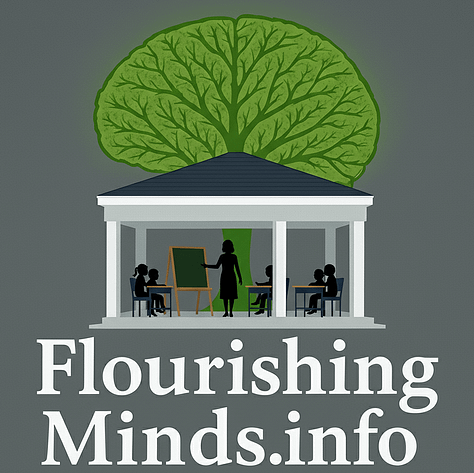
In one Flourishing Minds classroom, learning unfolds beneath a white, light-filled pavilion—a space open to air, curiosity, and conversation. A unit on ecosystems begins with a hike, evolves into a collaborative mural, and culminates in a student-led compost initiative. Intelligence here is not abstract—it’s embodied, relational, and alive.
The essential question for educators and parents shifts from “Which intelligence is my child?” to “How can I design environments that invite multiple intelligences to solve one meaningful problem?”
Teaching Intelligence Literacy
Just as we teach reading and numeracy, we must teach children—and adults—to recognize and name the many forms of intelligence. This is intelligence literacy: the ability to see brilliance in motion, rhythm, empathy, and design.
When students understand their own intelligences, they gain agency. They stop asking “Am I smart?” and start asking “How am I smart?” It replaces shame with curiosity, comparison with collaboration.
Intelligence literacy also empowers teachers. It helps them see beyond behavior to capacity, beyond compliance to creativity. It turns classrooms into studios, gardens, and workshops—places where minds are not managed but cultivated.
Practical Shifts: Designing for Plurality
How does this look in practice?
For Teachers
Move from lessons to experiences. Instead of writing an essay on feudalism (linguistic), students can build a scaled model of a medieval manor (spatial and logical), role-play social hierarchies (interpersonal), and compose a folk ballad (musical and intrapersonal).
For Parents
Observe where attention naturally gathers. If a child is restless, don’t suppress motion—redirect it. In a farm-integrated microschool, a kinesthetic learner might lead the morning animal-care routine, channeling energy into empathy and rhythm. The barn becomes a classroom; the body, a thinking tool.
The Case for the Learning Farm
The most powerful environments for plurality are those closest to life itself.
Planting a single garden bed engages nearly every intelligence:
- Logical & Spatial: mapping spacing, plotting sunlight, tracking data.
- Bodily-Kinesthetic: turning soil, planting seeds, building trellises.
- Naturalistic: perceiving the interdependence of soil, insects, and water.
- Interpersonal: collaborating on shared tasks and conflict resolution.
- Intrapersonal: cultivating patience and observation through care.
In this living laboratory, the child who struggles with a worksheet (linguistic) may excel at designing a drip-irrigation system (logical/spatial) or intuitively sense when soil is ready (naturalistic). The farm doesn’t just teach biology—it teaches being human.
As we often say at Flourishing Minds: “A test measures what you can recall. A portfolio reveals who you are becoming.”
Rethinking Assessment: Portfolios of Mind
If intelligence is plural, assessment must be too. Standardized tests capture only a sliver of human capacity. What we need are portfolios—living records of learning that honor diversity.
A portfolio might include a short film, a garden plan, a reflective journal, or a collaborative mural. It might document a student’s growth in empathy, design thinking, or ecological awareness. One portfolio might include a compost system designed for a local café, complete with soil analysis, community interviews, and a reflective essay on waste and renewal. These artifacts are not just evidence of learning—they are expressions of identity.
In microschools and learner-centered classrooms, portfolios become the heartbeat of assessment. They invite students to curate their own growth, to see themselves as makers of meaning. They also allow parents and educators to witness intelligence in its full bloom.
One morning at a Flourishing Minds learning farm, a group of students gathered to harvest carrots. As they pulled roots from soil, they debated food justice, sketched garden maps, and composed a song about microbial life. Intelligence was everywhere—in motion, in dialogue, in wonder.
Cultivating Brilliance: The Ecology of the Flourishing Mind
Human intelligence is not a hierarchy; it is an ecosystem.
A thriving forest needs its oaks and its mosses, its roots and its mycelium. Likewise, a flourishing classroom depends on many minds—some verbal, some visual, some kinetic, some contemplative.
The work of education, then, is ecological. It asks teachers and parents to be gardeners, not gatekeepers—to cultivate the conditions where diversity can thrive rather than ranking growth by height.
At Flourishing Minds, we believe education is not a factory—it’s a forest. Every child is a seedling of possibility. Our task is not to standardize their growth but to nurture the soil where many minds can flourish.
Gardner’s legacy is not a theory to admire but a lens to live by. It invites us to build schools that feel like ecosystems, not factories; to design learning that feels like life, not performance. It reminds us that intelligence is not the privilege of the few, but the birthright of all.
To the educators designing tomorrow’s classrooms, and the parents choosing today’s schools: remember that brilliance wears many faces. The child who hums while planting, who sketches while listening, who questions while walking—these are signs of intelligence in bloom.
And as the light filters across that open White Pavilion, where students gather around shared tables of learning, we glimpse what education can become: a place where many minds flourish—together.
Inspired by Howard Gardner’s Frames of Mind and subsequent works on Multiple Intelligences (Harvard University, 1983–2023).
THIS ESSAY WAS WRITTEN AND EDITED UTILIZING AI